Interview avec Ellen THE STRATEGIC VISION OF ANESRS
Times Higher Education interview
Interview de Helen avec Docteur Evens EMMANUEL et Docteur Jacques ABRAHAM, respectivement membre et Haut-Commissaire de l’ANESRS
February 23, 2026
THE STRATEGIC VISION OF THE ANESRS
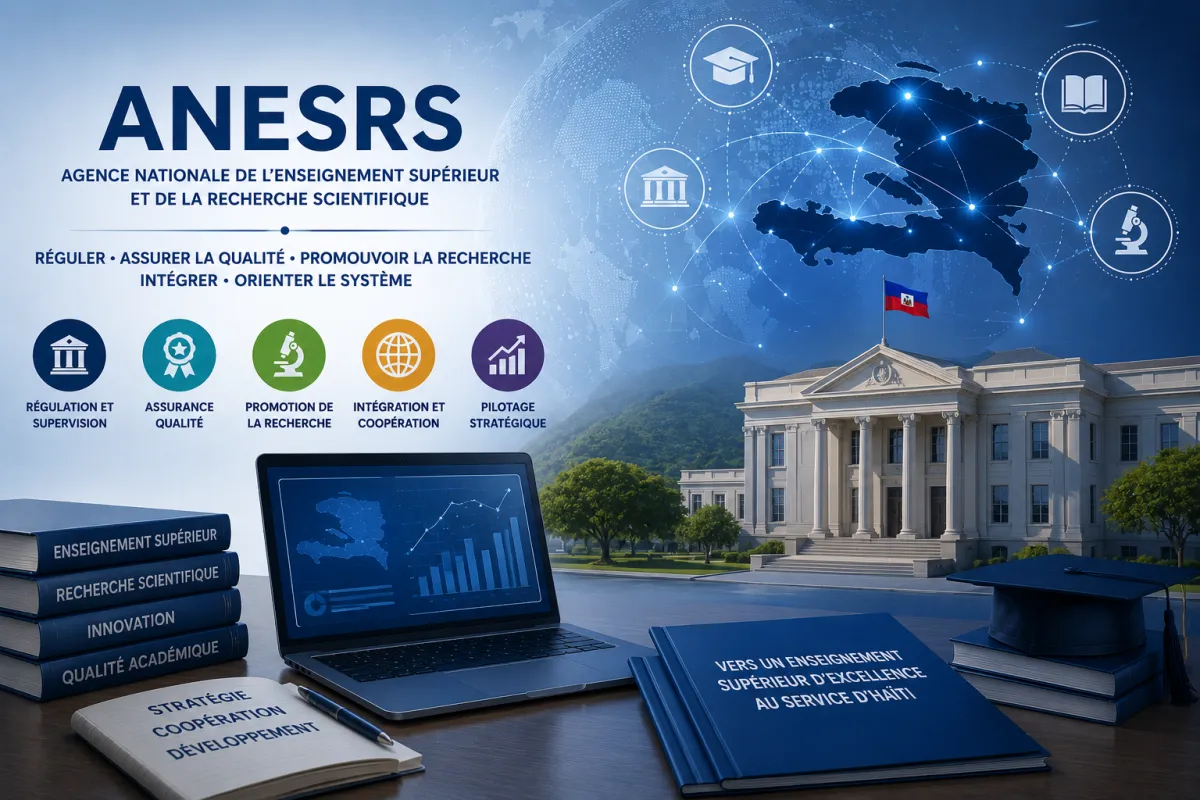
As set out in the decree and official communications, the mission of ANESRS, is to ensure:
1. Regulation and Oversight
·Regulate all higher education institutions (public and private);
·Oversee the academic and administrative governance of university institutions.
·Ensure the recognition and preservation of the quality of degrees awarded in Haiti.
2. Quality Assurance
·Establish and enforce national norms and standards for academic and research programs;
·Oversee program accreditation and issue formal recommendations to ensure academic quality.
3. Promotion of Scientific Research
ØStimulate scientific output, applied research, and innovation;
ØEncourage the transfer of knowledge and technology to the country’s strategic economic sectors.
4. Integration and Cooperation
ØPromote Haiti’s integration into regional and international academic, scientific, and research networks;
ØStrengthen cooperation between Haitian universities and international partners.
5. Strategic Steering of the System
üPropose national education policies and legislative or regulatory reforms concerning higher education and scientific research;
üProvide reports and strategic guidance to the State on the development of the sector.
Based on those missions and responsibilities, Evens and I, we have met Helen from Time Higher Education (THE) for an interview.
Can you tell me more about why the agency was launched now and what you hope to achieve? What are the first steps you will take?
Docteur Emmanuel: Response- The creation of the ANESRS addresses, above all, the need to provide the higher education and scientific research sector with a legal framework allowing for the regulation, standardisation, and development of the Haitian university space according to universally accepted standards. In my view, the launch of this structure can only enable Haitian universities to assert themselves through the quality of their teaching and the scientific, economic, and social relevance of their research.
According to the Ministry of National Education and Vocational Training (MENFP), there are more than 200 universities or higher education institutions in Haiti, of which 176 are recognised by the said ministry. Analysing the information available in the last two UNESCO Science Reports regarding the number of publications per million inhabitants, one must ask: why is it that Haiti, with 176 recognised universities, does not manage to achieve at least 15 publications per million inhabitants per year? In short, why is each of these 176 universities not yet able to produce at least one international publication in an indexed journal per year? This questioning must prompt the ANESRS to address the necessity of developing a career plan for Haitian academic staff, with specific criteria corresponding to the role of higher education teacher-researcher.
Personally, I believe that the ANESRS should study the possibility of establishing four databases:
One for students enrolled in the 176 universities, by assigning a national student identifier to each student;
One for teacher-researchers, with an identifier by field of competence;
One for research laboratories, structures that will be identified by field, central theme, and research axes;
One for the universities themselves.
At present, the CESRS is working on internal regulations, reflections on teaching, research, and innovation, as well as supervision and monitoring. It is due to organize a retreat in which it will present the results of the actions undertaken since its inauguration.
Can you tell me more about why the agency was launched now and what you hope to achieve? What are the first steps you will take?
Docteur Abraham: Response- Thank you, Helen, for that question. My colleague Evens set out a very good point in terms of the reason why the Agency exists; allow me to add some input in his point. The agency was launched at a moment where the university teaching is decrasalizing; and Haiti is, also, at a critical stage in the transformation of its higher education and research system. The growing need for quality assurance, stronger institutional governance, and international recognition of Haitian degrees made the establishment of a dedicated regulatory and strategic body both necessary and urgent.
We aim to build a coherent, transparent, and performance-driven higher education system that contributes directly to national development. Our objective is to ensure that universities and research institutions meet clear standards of academic excellence, promote innovation, and produce graduates who are competitive both nationally and internationally.
As first steps, we will focus on establishing national quality assurance standards, conducting an institutional mapping of higher education institutions, initiating consultations with key stakeholders, and setting up a structured accreditation framework. Strengthening dialogue and cooperation with universities will also be a priority to ensure that reforms are inclusive and sustainable.
Question: What difference will having this dedicated agency make?
Dr.Emmanuel: Response: As stated in the decree establishing this autonomous agency, the ANESRS is set to modernise and regulate the functioning of higher education and scientific research in Haiti. It must open itself up through dialogue with its key partners - universities, research laboratories, teacher-researchers, and students - to discuss the future of the Haitian university space with them. It is through horizontal pedagogy, mutual respect, and equitable scientific partnership at both local and national levels that the ANESRS and its partners will succeed in establishing the infrastructure essential for the recovery of higher education in Haiti.
It seems entirely relevant to me that the ANESRS should frame its approach within a theoretical framework that combines economic development with the development of knowledge. It must inevitably draw upon theories demonstrating that the level of economic development is intimately linked to the level of research development, as observed in many countries.
Question: What difference will having this dedicated agency make?
Dr.Abraham: Réponse: Evens, you are making a very good point. As a matter of fact, having a dedicated agency will bring coherence, structure, and accountability to the higher education and research system. Previously, regulatory functions were often fragmented or insufficiently coordinated. The establishment of this agency creates a clear institutional framework responsible for quality assurance, accreditation, and strategic oversight.
It will also strengthen public trust in higher education by ensuring transparency and measurable standards. In the long term, the agency will enhance the credibility and international recognition of Haitian degrees, support institutional governance, and promote a culture of continuous improvement across universities and research institutions.
Question: What are the biggest challenges facing higher education and research in Haiti? What challenges do you think the agency will face?
Dr.Emmanuel: Response: There are many. First, we must recall the aftermath of the 2010 earthquake, where 80% of university infrastructure, including research laboratories and university libraries, collapsed.
In the 2020 report produced by the Research and Innovation Commission of the CORPUHA (Conference of Rectors, Presidents, and Heads of Haitian Universities and Higher Education Institutions), the authors identified several key issues:
Funding: A total lack of real funding for higher education and research in Haiti. Research is very poorly funded within the responding universities.
Scientific Visibility: Bibliometric analysis of Haitian researchers' output on Web of Science reveals a low level of publication (883 articles from 1900 to 2017, of which 80% are co-authored with foreign researchers).
International Indexing: The output of researchers from CORPUHA member institutions is poorly listed in citation and abstract databases (measuring Impact Factors - IF) derived from peer-reviewed bibliographies and quality websites such as SCOPUS, considered the largest database for peer-reviewed citations and abstracts. It should be noted that a researcher’s citation rate provided by SCOPUS is an indicator of research performance within their university, which contributes to the scientific ranking of the country where the institution is based.
Global Rankings: Research conducted in the SCOPUS database regarding the performance of the country's institutions in terms of article publications in journals ranked in the Web of Science (WOS) reveals no Haitian university in these rankings. In the 2019 Times Higher Education World University Ranking for Latin America, Chile held 1st place, Venezuela 18th, Cuba 59th, and the Dominican Republic 122nd, whilst Haiti did not appear.
Digital Identity of Researchers: A very small number of Haitian researchers (26 in total) who are also members of CORPUHA institutions possess an ORCID (Open Researcher and Contributor ID). ORCID was established to create and maintain a registry of unique identifiers for researchers and provides a transparent method of linking researchers' activities to these IDs. It aims to resolve the problem of name ambiguity and researcher identification by assigning a unique, lifelong digital identifier. Unlike other IDs, ORCID is not limited to one discipline, geographical region, specific commercial publisher, or information provider.
I believe it is vital that the ANESRS, among other things:
Establishes contact with Times Higher Education (UK) and its Latin America and Caribbean (LAC) branch to plan the integration of Haitian universities into the annual ranking by 2027.
Develops a support programme for Haitian scientific journals. This would involve strengthening the national Open Science policy. Objectives: creation of websites for approved journals; partnership with Crossref for DOI assignment; creation of collections on HAL; adherence to the DORA declaration and recognition of reviewers via Web of Science.
Question: What are the biggest challenges facing higher education and research in Haiti? What challenges do you think the agency will face?
Dr. Abraham: Response: As Even said before, higher education and research in Haiti face several structural challenges. First of all, some of them must include limited financial resources, uneven quality among institutions, insufficient research funding, brain drain, weak infrastructure, and limited integration into international academic networks. Additionally, governance frameworks and quality control mechanisms have not always been fully consolidated.
Finally, the agency itself will face challenges such as building institutional capacity, ensuring compliance while maintaining collaboration with universities, and implementing reforms in a context of economic and social constraints. Another key challenge will be fostering a culture of evaluation and accountability without creating resistance.
However, these challenges also represent opportunities. With strong leadership, transparent standards, and constructive dialogue with stakeholders, the agency can become a catalyst for modernization and sustainable development within the higher education sector.
Question: The president’s speech says: “I remember a time when Haitian degrees were highly regarded, when Haiti was both a land of learning and a land of transmission. A time when the road to knowledge ran in both directions: people left Haiti to learn, but they also came here to study. This credibility has weakened in recent years, but it can be restored.” Can you tell me more about what the president is referencing and the historical context?
Dr. Emmanuel: Response: The history of Haitian universities confirms that between 1960 and 1985, numerous international students (notably Americans, Canadians, Caribbeans, Africans, and Europeans) completed their undergraduate studies in medicine and agronomy at the faculties of the State University of Haiti (UEH). Between 1995 and 2009, Haitian universities also continued to welcome students from abroad.
As part of international scientific cooperation, many Haitian teacher-researchers have benefited from scholarships to pursue their Master’s and Doctoral degrees overseas. Similarly, several foreign researchers have undertaken scientific mobilities lasting several months or years within university research laboratories in Haiti. However, due to the social instability that has taken hold in the country for over a decade, international scientific cooperation is now facing serious challenges that must be addressed to restore this historical prestige.
Question:The president’s speech says: “I remember a time when Haitian degrees were highly regarded, when Haiti was both a land of learning and a land of transmission. A time when the road to knowledge ran in both directions: people left Haiti to learn, but they also came here to study. This credibility has weakened in recent years, but it can be restored.” Can you tell me more about what the president is referencing and the historical context?
Dr. Abraham: Response: My colleague Evens is right. Indeed, the President is referring to an important period in Haiti’s intellectual and academic history when the country played a significant role in regional education and knowledge production. Throughout much of the 19th and 20th centuries, Haiti was recognized as a center of thought, law, medicine, literature, and political philosophy in the Caribbean and beyond. Haitian universities and intellectual institutions contributed meaningfully to national development and regional discourse.
Institutions such as Université d’État d’Haïti, founded in the early 20th century, and earlier higher learning traditions that date back to the 19th century, helped shape generations of professionals, scholars, and public leaders. Haitian jurists, physicians, educators, and writers were trained locally and often went on to make significant contributions nationally and internationally. At the same time, Haiti welcomed students and thinkers from across the region, particularly in fields such as law, humanities, and medicine.
However, over recent decades, structural challenges, including political instability, economic constraints, underinvestment in research infrastructure, and significant brain drain, have weakened the institutional capacity and international visibility of our higher education system. This is the context in which the President speaks of credibility having diminished.
Importantly, the President’s message is not nostalgic; it is strategic. It acknowledges that credibility is not a symbolic attribute, it is built through quality assurance, strong governance, research productivity, and international cooperation. The establishment of a dedicated agency reflects a forward-looking commitment to restoring that credibility through measurable standards, transparent accreditation processes, and stronger partnerships.
We do not view restoration as a return to the past, but as a modernization effort grounded in Haiti’s intellectual tradition and aligned with global academic standards. With the support of international partners, we believe Haiti can once again become not only a place where students leave to study, but also a place that attracts knowledge, collaboration, and innovation.
Question: How far do you think the social problems Haiti currently faces will affect the work the agency will do?
Dr. Emmanuel: Response: The social problems currently facing Haiti impact every function of the Haitian social system. They directly affect the quality of education in the broadest sense, and higher education in particular. The buildings of several faculties at the State University of Haiti (UEH) have been looted and set on fire; the premises of several private universities have suffered the same fate, and the equipment in numerous research laboratories has been vandalised.
In spite of this somber reality, educational institutions have organised themselves to provide online services. Researchers have drawn upon intellectual reflection to better coordinate resistance against these hardships. The ANESRS will be responsible for adopting strategies, in consultation with stakeholders across the Haitian university space, to develop mechanisms that ensure the continuity of higher education and scientific research within the country.
Question: How far do you think the social problems Haiti currently faces will affect the work the agency will do?
Dr. Abraham: Response: Haiti’s current social challenges, including economic constraints, security concerns, and institutional fragility, undeniably create a complex operating environment. It would be unrealistic to suggest that higher education reform takes place in isolation from these broader realities.
However, rather than viewing these challenges solely as obstacles, we see them as reinforcing the urgency of our mission. In times of instability, strong institutions become even more essential. A structured, transparent, and credible higher education system contributes to stability by building human capital, reinforcing professional standards, and restoring confidence in public institutions.
The agency’s role will therefore be both technical and strategic. We must design reforms that are realistic, phased, and adapted to current constraints, while maintaining long-term ambition. We will prioritize collaboration, institutional capacity-building, and international partnerships to ensure resilience. In many ways, the current context makes our workmore necessary, not less.
Question: How will an increased focus on higher education support Haiti’s national development?
Dr. Emmanuel: Response: In an article recently published in the "Sciences et Société" section, Vijonet Demero states: “Higher education in the Global South is undergoing a period of profound transformation, characterised by massification, the rise of the private sector, a chronic deficit in public funding, and fragile governance mechanisms. Within this framework, Haiti occupies a particularly delicate position: with more than 200 higher education institutions (HEIs) and only 0.08% of GDP dedicated to R&D, the country faces a double deficit in terms of regulation and quality.”
Furthermore, Alexandra Emmanuel and her collaborators note that Haiti finds itself in a particularly critical situation where extreme environmental vulnerability, persistent institutional fragility, and marked socio-economic precariousness converge. According to climate experts, rising global temperatures pose risks to both the environment and human health. In terms of public health, this has led to an increase in the prevalence rate of vector-borne diseases, notably dengue, Zika, and chikungunya, the emergence of which is linked to the introduction of invasive mosquito species.
In the absence of an intensified strengthening of higher education and research, how will the country be able to draw upon science to approach and address its development lag in a different way?
Question: How will an increased focus on higher education support Haiti’s national development?
Dr. Abraham: Response: Higher education is not simply an academic matter; it is a structural driver of national development. Countries that invest strategically in higher education and research strengthen their capacity for innovation, economic diversification, institutional governance, and social mobility.
By improving quality assurance, strengthening research, and aligning academic programs with national priorities, Haiti can better address key sectors such as public health, agriculture, infrastructure, environmental resilience, digital transformation, and governance reform.
Moreover, a credible higher education system helps retain talent and gradually mitigate brain drain. It fosters entrepreneurship, supports evidence-based policymaking, and enhances the country’s ability to engage competitively in regional and global markets.
Question: The State University of Haiti has been critical of the decision to launch the agency. How do you feel about their concerns related to autonomy and independence?
Dr. Emmanuel: Response: Firstly, I would like to commend our colleagues at the State University of Haiti (UEH) for their reaction. This is a civic-minded approach that can only lead to responsible, scientific, and equitable discussions between the ANESRS and the various stakeholders of the Haitian university system.
The ANESRS is not intended to infringe upon the autonomy and independence of universities. The vital question today is how the actors within the Haitian university system will come together to provide the country with a national scientific policy - one that will specifically prioritise the professional status and valuation of university professors.
Question: The State University of Haiti has been critical of the decision to launch the agency. How do you feel about their concerns related to autonomy and independence?
Dr. Abraham: Response: In the same way as my colleague Evens, we have great respect for the historic role and intellectual leadership of the Université d’État d’Haïti. Its concerns regarding autonomy and academic independence are legitimate and deserve careful consideration.
It is important to clarify that the agency is not designed to undermine university autonomy. On the contrary, its purpose is to strengthen institutional credibility through transparent standards and nationally recognized quality assurance mechanisms. Around the world, regulatory and quality assurance bodies coexist with strong institutional autonomy. The two are not contradictory — they are complementary.
Our approach is based on dialogue, consultation, and partnership. We believe autonomy must be preserved, while regulation, accountability and quality standards are strengthened. The objective is not control, but coherence, fairness, and international alignment. We are committed to ensuring that implementation respects academic freedom and institutional identity.
To conclude, neither autonomy, nor independence does not exclude regulation and accountability!
Question: What has the response been like from universities and academics in Haiti more widely?
Dr. Emmanuel: Response: The ANESRS has taken note of several articles published in the national press and in popular science journals. In this regard, the network of Public Universities in the Regions (UPR), which comprises ten institutions, has sent an excellent formal letter to the agency.
One of the most strategic responses can be found in the paper by Vijonet Déméro:
Déméro, V. (2026). University Governance and Quality Assurance in Higher Education: Issues, International Comparisons, and Perspectives for Haiti. InfosNation - Espace Sciences et Société, 21 February 2026.
In this work, the author analyses the challenges of governance and quality assurance, providing essential perspectives for the development of the Haitian university space.
Question: What has the response been like from universities and academics in Haiti more widely?
Dr. Abraham: Response: The response has been mixed, which is natural for any structural reform. Some institutions and academics have expressed concerns, particularly about governance and implementation mechanisms. Others have welcomed the initiative, recognizing the need for clearer standards, improved accreditation processes, and stronger national coordination.
Importantly, there is broad recognition that the system requires modernization. Many academic leaders understand that international competitiveness, research visibility, and degree recognition depend on credible quality assurance frameworks.
Therefore, our priority must be to maintain open communication channels and encourage participatory reform. Building trust takes time, but we are seeing increasing engagement in technical discussions, which is an encouraging sign.
Question: Do you have plans to increase international collaboration and what might this look
Dr. Emmanuel: Response: It is vital to approach this question from the theoretical standpoint of equitable scientific partnership. As Emmanuel and Emmanuel (2025) state:
"Universities are universally recognised as engines of economic growth and social mobility. However, this mandate is often undermined by obsolete collaboration models between major institutions in the North and universities in the South. For too long, the dominant model has functioned more as a form of research extraction, where the North primarily dictates the agenda and captures intellectual property, treating Southern institutions mainly as data collection sites. This practice directly contradicts the innovative capacity upon which universities must now rely to flourish. We must ask ourselves: how can the global academic world truly benefit from new ideas if the structure of scientific cooperation between Northern and Southern countries marginalises the production of knowledge in regions facing the most complex societal and environmental challenges? True innovation requires a fundamental shift towards the co-creation and co-construction of knowledge."
Equitable partnerships should include: the mutual definition of priorities, shared funding allocation that takes local costs into account, and joint intellectual ownership of research results. Furthermore, global visa and immigration restrictions—a challenge highlighted in a Nature editorial—must be eased to ensure the free movement of researchers, and not just students.
Partnership involves collaboration between multiple stakeholders seeking to implement a project or a common event, whilst maintaining their autonomy and identity. The inclusion of the concept of autonomy in this definition already highlights the association between partnership and equity.
Indeed, the adjective "equitable" refers to that which respects the rights of each party, according to the principles of justice. Consequently, the term "equitable scientific partnership" relates to the concepts of consultation and intersectorality. These terms describe the depth of relations and qualify the nature of the relationship between the stakeholders involved. In the case of equitable scientific partnership, this must manifest as a shared will to produce knowledge and techniques in the service of development and collective well-being, particularly regarding sustainable development.
Both the North and the South currently face major socio-environmental challenges and the necessity of achieving the Sustainable Development Goals (SDGs) together. Furthermore, partnership is itself one of the SDGs: Goal 17 aims to revitalise the global partnership for sustainable development to ensure that no one is left behind, which also implies partnerships between public authorities, the private sector, and civil society.
Question: Do you have plans to increase international collaboration and what might this look like?
Dr. Abraham: Response: Yes, international collaboration is a central pillar of our strategy. Haiti’s higher education system cannot evolve in isolation. Strengthening partnerships will help us benchmark standards, develop joint research initiatives, and expand academic mobility.
In practical terms, this may include:
Developing bilateral and multilateral agreements with foreign universities and quality assurance agencies.
Encouraging joint research programs and co-supervised doctoral initiatives.
Supporting faculty and student exchange programs.
Aligning accreditation processes with internationally recognized frameworks.
Engaging with regional and global academic networks.
International cooperation will not be symbolic; it will be technical, structured, and mutually beneficial. Our ambition is to position Haiti as a credible and reliable academic partner, capable of contributing to global knowledge while strengthening its own national priorities.